
Who gets to build in AI (and who’s making that possible)

Here’s a rather late rant that probably would have been better left in my notes app, but unfortunately for everyone involved, I’ve clearly lost that battle.
A while back I read a headline in one of the biggest tech publications in Sweden about how women are missing the AI train. And it just so happened to land on the exact same day as new numbers showing that women are still taking the majority of parental leave. Still the ones staying home when the kids are sick. Still carrying most of the unpaid work that makes literally everything else function.
So I’m sitting there, reading this very confident analysis about how women aren’t showing up in AI, and all I can think is: I’m sorry, when exactly were we supposed to?
Because whilst it’s a very clean narrative if you only look at the outcome (who’s building, who’s shipping, who’s “in the room,”) - it does, unfortunately, require you to ignore just about everything that happens before anyone even gets close to the platform.
The premise is already broken
We talk about “getting on the train” like it’s just a matter of deciding to. Like everyone is standing on the same platform, looking at the same departure board, making a choice about whether to step on or not.
They’re not.
Some people get long, uninterrupted stretches of time. The kind you actually need if you’re going to learn something new, experiment, fall down rabbit holes, build anything beyond surface level.
Other people get time in fragments. Time that’s constantly interrupted, rescheduled, negotiated around everything else that needs to happen. Time that disappears entirely the second someone gets sick, something breaks, or a preschool closes early.
And please let us not pretend that we don’t already know who those people are.
Women are still doing the majority of unpaid labor. Still the default parent in most households. Still the ones expected to absorb the unpredictability of everyday life. Which means that when we talk about who is early in AI, who is “leaning in,” who is ahead, who is building, we’re not just looking at skill or ambition. We’re looking at time. And more specifically, we’re looking at who gets to have time that stays theirs, and who doesn’t.

Let’s go with the train for a second
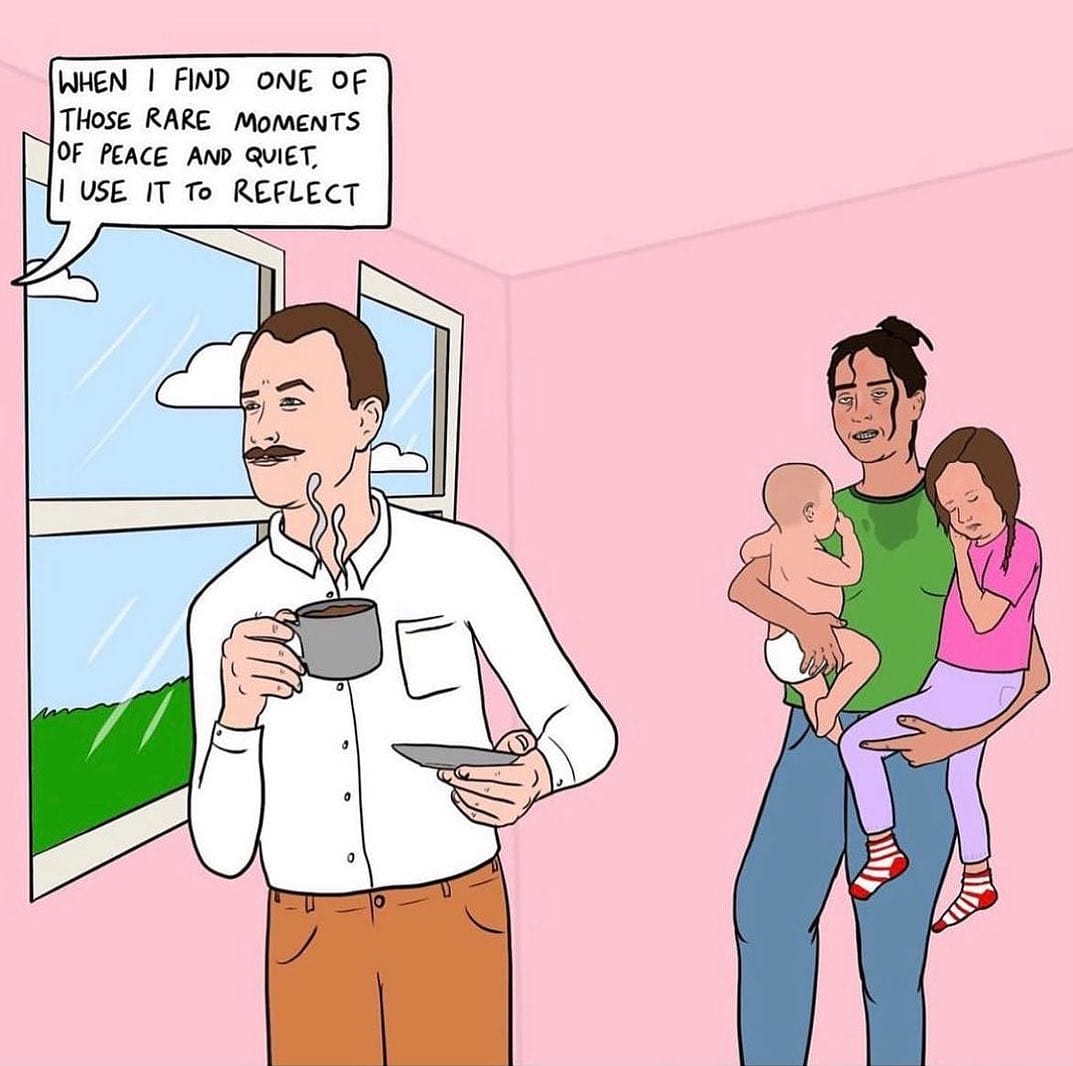
We’re told to get on it. Not miss it. Hurry up before it leaves the station, because apparently this one decides the rest of our careers. But we’re not exactly strolling onto a platform with a coffee in hand, casually deciding whether we feel like hopping on.
A lot of us are literally at home, vabbing sick kids. That’s where the time is going. That’s what the day turns into. Plans collapse, meetings move, whatever you thought you were going to do gets quietly replaced by something else that suddenly matters more.
And sure, in theory, you can still try to make it work. You can try to carve out time anyway. Strap the diaper demons into a BabyBjörn, head out, juggle everything at once. Answer Slack messages with one hand, google something vaguely technical with the other, try to hold a thought for longer than five minutes without it being interrupted by someone needing something.
You can try to make your way to the station like that. And then there’s a man already on the train, leaning out the door, yelling “WHY AREN’T YOU GETTING ON?”
Like we’re just standing there. Like we haven’t moved. Like the only thing between us and the train is effort.
Maybe, and this is a wild thought, he could get off the train for a second. Take the kid. Do the laundry. Handle some of the things that keep pulling us back. Free up the hands that are apparently supposed to be building the future.
Instead of standing there, genuinely confused, wondering why we haven’t made it yet.
Even if you make it to the platform
Somehow. Slightly feral, already late, having fought for every uninterrupted minute. That still doesn’t mean you’re getting on. Because the ticket isn’t priced the same. And more importantly, no one is offering to pay for it.
Most things that matter require capital. And men still control the majority of that capital: in funds, as angels, across the entire system. And only a tiny fraction of it, hovering somewhere around one percent depending on how you count it, ends up with female founding teams.
So even here, even after everything it took just to show up, there’s another barrier waiting. And this one is quite literally out of our hands.
And yes, software is cheaper now. AI makes it possible to build things faster, with less upfront cost, and you can absolutely put something together without raising money. But that’s only really true iif the underlying tools actually work for what you’re trying to build.
And they don’t, at least not equally.
A lot of the current AI stack works remarkably well for problems that have historically been built, documented, and funded by men. The data is there, the use cases are familiar, and you can move quickly, stack tools on top of each other, and ship something that looks and behaves like a product without needing to question the foundation too much.
If you’re building in areas that haven’t been as well represented, where the data is thinner or just missing entirely (women’s health being a pretty obvious example), you don’t get to move like that. What looks “cheap” and fast for some becomes slower, more manual, and more uncertain for others, and the idea that you can just spin something up without capital starts to fall apart pretty quickly.
So even here, even once you’ve made it onto the train, the difference shows up again: in what you’re able to build, how fast you can move, and how much of the groundwork you’re expected to do yourself before anyone is willing to fund it.
(how tired are we getting of the train metaphor? I’m like having a love-hate relationship with it as this point 🚂)
This isn’t theoretical
I can see it very clearly in my own life. And probably not in the way you would initially think.
I’m deep in AI at this point. A large part of how I work, think, and build is shaped by it. I spend time experimenting, trying things, figuring out what’s possible and what isn’t.
My partner, on paper, should be the one ahead. He has a technical background. This is much closer to what he’s trained to do.
But he’s not. (don’t get me wrong, he’s more in than most, but not as in with me. Again, sorry honey - catching strays all over the place here)
Because he’s the one who knows when the dentist appointments are. He’s the one who knows the other parents at preschool. He’s the one keeping track of who’s invited where, what needs to be packed, what needs to be remembered next week, not just today.
He’s the one doing pickups, drop-offs, planning around sick days, reshuffling everything when something inevitably falls apart. It’s not just time, it’s the constant background processing of everything that needs to happen for life to keep running.
He’s carrying that. And I’m not.
I’m essentially the dad in this family.
Which, for better or worse, means I get to work the way a lot of men do. I do the long days, weeks, months. I get long stretches of uninterrupted time. I get to follow a thought all the way through. I get to stay in it. I don’t have to constantly context-switch or hold ten other things in my head at the same time.
And that’s the reason I’m ahead. Not because I’m smarter. Not because I care more. Not because I’m better at this. But because I have the space to be.
And at some point you have to be honest about what that actually is: someone is always subsidizing someone else’s productivity. In my case, it’s him. In a lot of other cases, it’s women.
A lot of the men who seem to be moving quickly in AI, building, experimenting, staying ahead - they’re able to do that because someone else is making sure everything outside of that work doesn’t fall apart.
And this is the part where I keep getting stuck. Because we keep talking about women like we’re the variable here. Like something about us is off. Interest, urgency, whatever. When everything up until this point has very obviously not been about that.
Honestly, it’s tiring how everyone (men) keeps doing narrative backflips to frame systemic conditions as personal shortcomings. At this point, we can’t still be misunderstanding the problem - which makes it feel less like confusion and more like a mix of laziness and defensiveness, choosing to describe it in a way that keeps the blame exactly where it’s always been.
The AI space right now is intense for everyone. Things are moving constantly, new tools, new models, new workflows, and even people who are fully immersed in it are struggling to keep up. It’s not effortless for anyone. Men included.
And somehow, the expectation is still that women should match that pace - even though that pace is only sustainable because we’re the ones picking up everything that would otherwise slow it down.
The unpaid work doesn’t disappear. The interruptions don’t disappear. The mental load of keeping life running doesn’t pause because there’s a new model release. The extra effort it takes to show up looking even remotely “put together” doesn’t go away either- and that’s before we even get into the fact that the entire structure of how we work is built around a rhythm that was never designed with women’s biology in mind in the first place (I could do another rant just about that but I have at least some level of self-restrain)
And still, the expectation is: Move just as fast. Build just as much. Stay just as up to date. Catch the train.
At some point it stops sounding like a serious argument and starts sounding like either willful blindness or a very convenient way of shifting responsibility. If I was just a tiny bit more conspiratorial, I’d almost think the system was working exactly as intended: keep the structure as is, then act surprised at who falls behind.
Because if even the people with the privilege of time, capital, and being the default beneficiaries of how this entire system is built are struggling to keep up, what exactly are we expecting from the ones who aren’t?
So let’s stop pretending
Yes, women are missing the metaphorical AI train. But let’s be very honest about why.
Participation here comes with a cost. In time, in energy, in capital. And right now, that cost is not distributed equally - and guess what, women aren’t the ones doing the distributing.
So, we end up with exactly the outcome we’ve designed for - and then turn around and analyze it like it’s some kind of mystery.
It isn’t.
It’s about who has uninterrupted time. Who has access to capital. Who gets to build on top of existing data instead of having to generate it from scratch. And who has someone else absorbing everything that would otherwise slow them down.
If you actually want women building in AI, the answer isn’t another round of commentary about where we are. Start with the basics:
50% of parental leave.
50% of VAB.
50% of caring for aging parents.
50% of the household chores.
And while we’re at it: more than one percent of venture capital would be a good place to start. Double it with your precious 10x logic and we’re still nowhere near parity.
And then, and only then, we can have a serious conversation about participation.
Until that shifts, I don’t need to read another analysis about women “falling behind.” We’re not behind. We’re carrying.
You don’t get to structure the entire system this way and then act surprised at the outcome.
Pick up the damn kids, fund the ticket, and we’ll meet you in the bistro 🚂🥂✨

One of the Girls Has Money Now is where you go from being interested in startups to actually understanding how investing works.
Most people stay on the outside of this world for years: reading, following, trying to piece it together.
We make it click.
Inside, you learn by getting closer to how investing actually works:
💌 Biweekly deep dives with real-world context
🎓 A full crash course (start-to-finish, no prior experience needed)
🎤 Live AMAs with investors and founders
🤝 Shared dealflow + optional opportunities to invest together
💕 Physical & digital social events
By women, for women, with women 💅🏻




Member discussion