How to be professional
The world is ending in at least thirteen different ways, and apparently the correct response is to keep that observation for after hours. Actually, it's preferable you don't talk about it at all. Or, if you must, to do it somewhere completely separate from the place, the people, and the systems you spend forty hours a week embedded within.
I can hardly believe we've allowed ourselves to bamboozled into thinking silence equals professionalism, as if we’re in some severance-like state where work is meant to be completely disconnected from the rest of the world. As if the same historical structures of marginalization somehow stop at the office door. As if caring about other humans is a hobby we take up after we clock out, and standing firm and open in our values is showing people “too much" of ourselves - the parts deemed excessive, that needs to be managed, contained, edited down to remain acceptable.

Who exactly is this professionalism for?
I keep trying to understand the thinking behind this idea that opinions are unprofessional, and the most generous explanation I can come up with is that fabricated conformity is treated as a way to keep all doors open. Don’t say too much. Don’t be too clear. Don’t narrow your options. Be acceptable to as many rooms as possible, just in case.
But I don’t understand the obsession with keeping every door open.
Open to whom. And for what.
Because this expectation doesn’t land evenly. It never has. It doesn’t touch the people who already fit the default, who move through institutions without friction, whose bodies, accents, histories, and assumptions already read as neutral. It lands on the people who have spent their careers adjusting themselves to rooms that were not built with them in mind.
It lands on the female CEO who has smashed glass ceilings for years and then been expected to walk calmly across the broken glass, only to be told that naming gender out loud is somehow bad for business. It lands on migrants who are expected to perform gratitude and silence in the face of racism. It lands on anyone whose existence has always been treated as contextual, political, or optional.
Silence keeps these issues static. Silence also demands a split:
One self for work. Another for the world as it actually is.
A constant act of translation and containment that costs energy, clarity - and honestly? sanity.
Trust me, if I work with you, I want to know who you are. Your values. Your integrity. Even the messy human middles. And if someone doesn’t want to work with me because of my beliefs, they are not people I want to work with anyway.
All of this reminds me of a well-meaning friend, years ago, pre-babies and husband, telling me to remove the word “feminist” from my Tinder profile. It would reduce my number of connections, she said. As if a man who refuses to date a feminist is ever someone I’d look at twice. As if my right to exist as equal on this earth to the men on it is a side issue, easily traded away for the comfort of being liked by them.
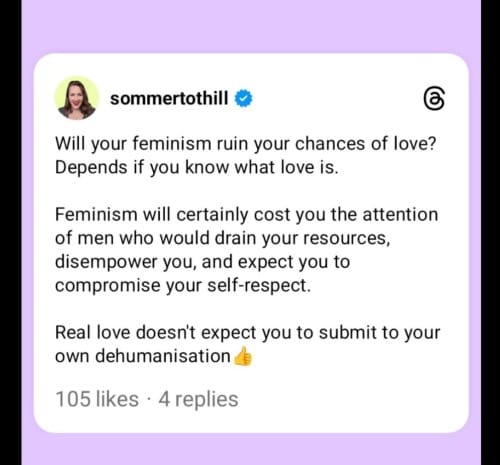
I don't want all doors open, neither in love nor in business. I'm only interested in the right ones, and I'd prefer to weed out the wrong ones early.
Because not knowing the values of the people you trust to bring your business to life is a liability in my eyes.
Personally, I will always side-eye the judgment of someone who hires a man who says it’s fine to kill some Palestinian children because they are “only children NOW.” I will always question the integrity of someone who hires a man who claims women make worse board members because we are biologically engineered to compete with each other. I will never trust the moral compass (or critical thinking) of someone who waves off rape accusations as women playing “political games.”
Yes, all of these are real examples. Yes, I judge everyone involved.
Are you really acting professional or are you just a white wealthy heterosexual man acting like himself and in his own personal interest?
For some people, professionalism is frictionless. The way they speak, the way they move through rooms, the assumptions they carry, already line up with what institutions reward. There’s nothing to suppress. Nothing to translate. Acting “professional” feels natural because it mirrors who they already are and who they are allowed to be.
For others (like young girls with still undiagnosed ADHD, a overdeveloped sense of justice and zero verbal filter 😅) it’s a performance learned early. Switching language. Switching tone. Editing reactions in real time. Deciding which parts of yourself are safe to surface and which ones need to stay hidden, not because they interfere with the work, but because they might make other people uncomfortable. A constant calibration that runs alongside the actual job.
And in addition to that: If you’re broadly okay with how the world is structured right now, staying silent doesn’t cost you much. You can treat neutrality as politeness. You can call it professionalism and mean it. The gap between what you see and what you’re asked to say is manageable if even noticeable at all.
But if you’re not okay with how the world looks today, if the violence, the exclusions, the hierarchies are not abstract to you, then silence isn’t neutral at all. It asks you to swallow things that matter. It asks you to leave parts of yourself outside the room. It turns “being professional” into a daily exercise in self-erasure.
If politics staying exactly as they are isn’t hurting you, or is even benefiting you, of course it’s easy to want politics kept out of the room. Easier to call it impolite. Easier to say it doesn’t belong at work. Easier to treat it as something abstract, distant, safely theoretical.
I can see where you stand even when you're standing there silently.
But your neutrality isn’t real. You have opinions. They just happen to line up perfectly with the way things are, which means you don’t ever have to say them out loud. You’re not more professional than me because you don’t post feminist rants or speak up about Palestine, (which at this point is literally opposition to genocide which really shouldn't be that controversial but times are sure weird).
Your silence is a choice. It’s still an opinion. Mine is to try to change things. Yours is to let them stay as they are. Both of those positions carry values. Both should be seen and named.
You tell me I’m showing too much of myself, as if that’s the problem here, but I see you clearly too. I see what you’re willing to live with. I see what you’re willing to ignore. I see exactly where your comfort line is drawn.
So, let's get unprofessional
This last part is for the women who know all of this already.
The ones who see the erasure for what it is, who feel the split in their bodies every day, who understand exactly how fake this separation between “human” and “professional” is. The ones who are partially liberated.
Free enough to notice. Not free enough to ignore the consequences.
The woman who thanked me quietly for speaking about gender, because she "isn’t allowed to talk about gender on linkedin". The women who step just far enough outside the lines to breathe, then step back in again to survive. The ones who know the punishment is real. Reputational. Financial. Social. Sometimes all three at once.
I unfortunately don’t have a playbook for you. I don’t have answers. I don’t know how to play this game without cost.
All I have is recognition, solidarity, and zero judgement
One of the Girls Has Thoughts Now is my personal newsletter — essays, observations, and the occasional unfiltered rant about work, power, money, and being a woman in all of it. You can subscribe to this one for free.
One of the Girls Has Money Now is the investment club. For €120/year, you get a 6-part angel investing crash course, live events, biweekly deep dives, and access to an active community of women learning how to invest in startups — together.
Read along for free. Or join the club and start putting your money to work. 💸
Member discussion